

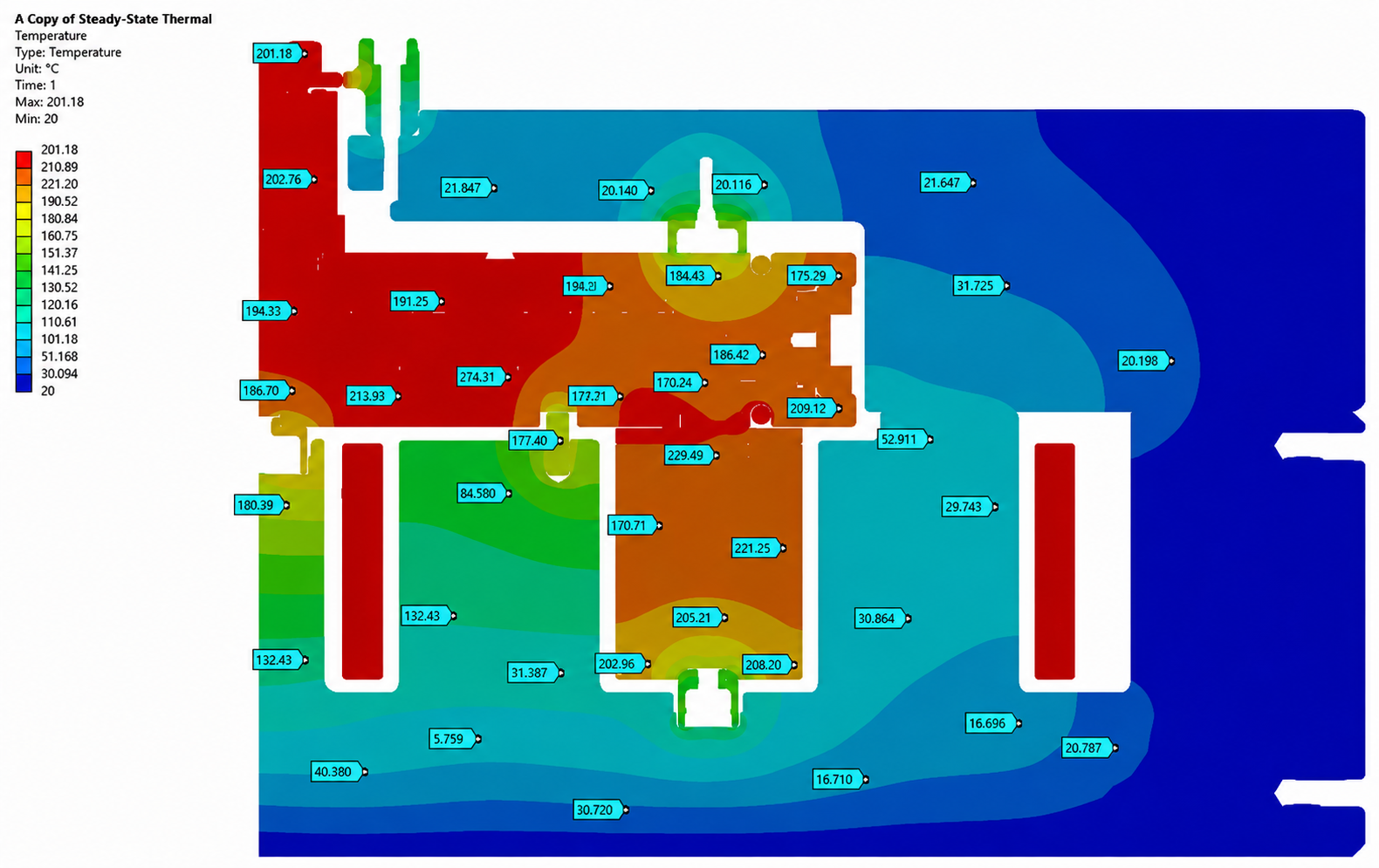
In high-cavity injection molding, hot runner performance is not determined only by mechanical accuracy or flow-path geometry. Thermal balance within the hot runner system plays an equally critical role in ensuring that molten polymer reaches every cavity under consistent processing conditions.
Manifold thermal analysis helps engineering teams evaluate how heat is distributed through the hot runner assembly, where heat is being lost, and whether the system can maintain stable temperatures across all drops during production.
Why Manifold Thermal Analysis Matters
The objective of manifold thermal analysis is to study the temperature distribution within the hot runner manifold and identify areas of heat loss, excessive temperature variation, or thermal imbalance. A well-designed manifold should deliver resin to each nozzle at a consistent thermal condition so that cavity-to-cavity variation is minimized.
This study is different from flow analysis. Manifold thermal analysis generally focuses on heat transfer through the manifold, heaters, contact surfaces, and surrounding mold plates. If shear heating, pressure drop, or melt-temperature rise caused by resin flow is a concern, those effects should be evaluated separately through rheological or flow simulation.
How Engineers Evaluate Thermal Behaviour
A thermal study is usually performed using the first complete hot runner assembly model prepared by the designer. The analyst reviews the manifold geometry, heater layout, contact areas, support features, and surrounding mold-plate conditions before refining the model for simulation.
Based on simulation results, design changes may be recommended to improve heat distribution, reduce losses, or achieve better balance between drops. These recommendations are then incorporated into the final manufacturing drawings and engineering documentation.
Understanding Heat Sources and Heat Sinks
The main heat losses from a manifold into the mold plates occur through physical contact points such as manifold locators, spacer disks/nuts, and anti-rotation devices. In thermal analysis, these features are commonly treated as heat sinks because they create conductive paths for heat to move away from the manifold.
Heater elements, by contrast, are treated as heat sources. The relative position, size, and distribution of heaters and heat-loss features largely determine the thermal balance of the manifold or bridge assembly inside the hot half plates.
How Thermal Imbalance Affects Molding Results
Poor thermal balance can directly affect molding performance, especially when processing resins with narrow operating windows or high thermal sensitivity. Excessive temperature variation may increase pressure drop, affect cavity-to-cavity filling balance, reduce colour-change efficiency, and create areas where material remains in the system longer than intended.
In severe cases, localized overheating or stagnation can lead to polymer degradation inside the hot runner system, resulting in defects such as discoloration, black specks, unstable processing, or reduced part quality.
Engineering Takeaway
Manifold thermal analysis is not just a validation step; it is a practical engineering tool for building more stable, predictable, and production-ready hot runner systems. By understanding where heat is added, where it is lost, and how it is distributed, designers can reduce the risk of thermal imbalance in hot runner systems before the mold reaches the trial stage.